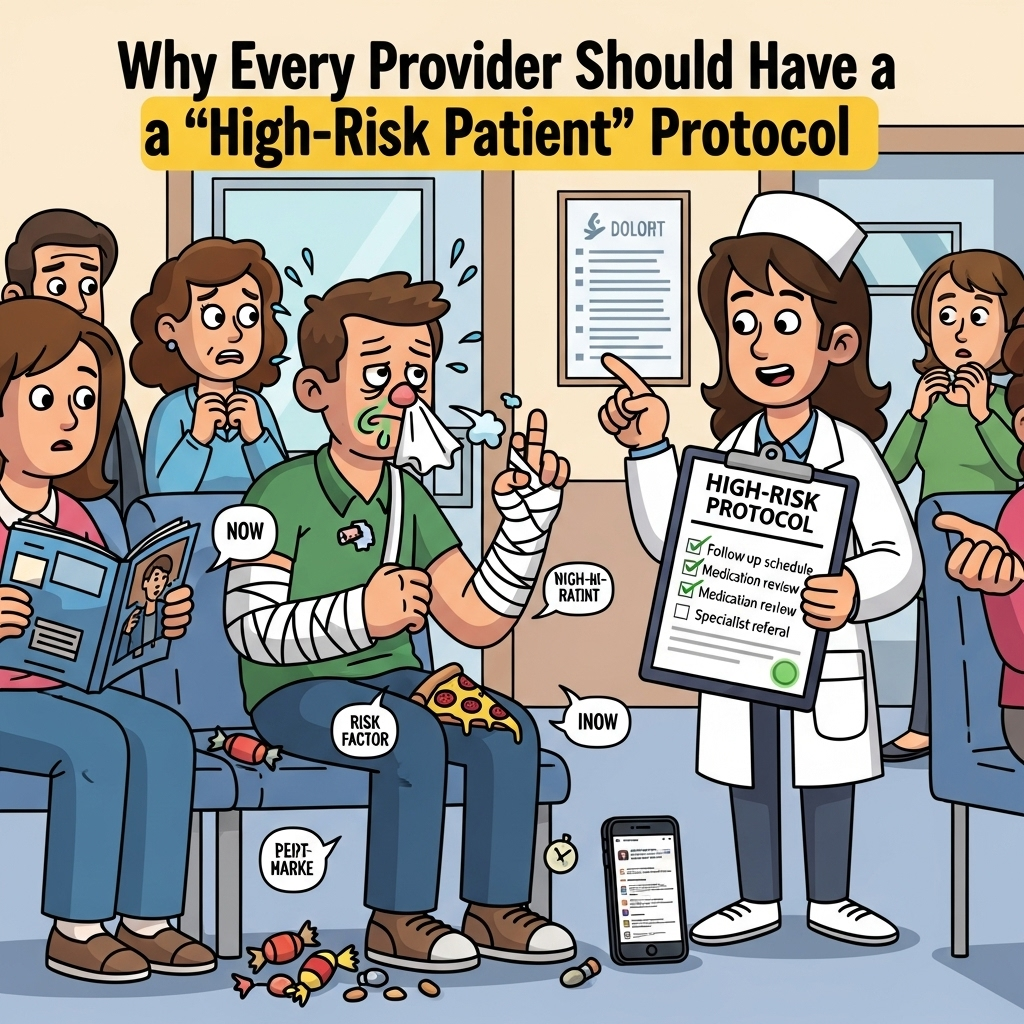
Why Every Provider Should Have a “High-Risk Patient” Protocol

Doug Jorgensen
May 11, 2025
Every provider has them—patients whose situations, behaviors, or medical needs carry a higher-than-normal level of clinical, legal, or compliance risk. These aren’t necessarily “bad” patients. In fact, some are among the most vulnerable and in need of consistent, compassionate care. But the stakes are higher, the scrutiny is greater, and the margin for error is razor thin.
That’s why I believe every practice—large or small—should have a formal high-risk patient protocol. Without it, you’re relying on memory, personal judgment, and fragmented communication, all of which are recipes for inconsistency and vulnerability.
Who Qualifies as High-Risk?
High-risk doesn’t just mean “difficult.” It means there are factors that increase the likelihood of harm to the patient, the provider, or the practice if protocols aren’t followed precisely. Examples include:
- Controlled Substance Patients – Especially those on chronic opioids, benzodiazepines, or amphetamines.
- Frequent ER Visitors – Multiple acute care visits without follow-up coordination.
- Noncompliant Chronic Disease Patients – Skipping labs, imaging, or follow-ups for conditions like diabetes or heart disease.
- Patients with a History of Manipulation or Boundary Testing – As covered in article #103.
- Those with Multiple Prescribers – Often revealed through prescription monitoring programs (PMP).
Key Components of a High-Risk Patient Protocol
- Clear Identification
- Flag the patient in the EHR with a discreet but visible alert for all providers and staff.
- Flag the patient in the EHR with a discreet but visible alert for all providers and staff.
- Standardized Documentation
- Use structured templates to ensure every encounter captures necessary compliance elements.
- Use structured templates to ensure every encounter captures necessary compliance elements.
- Mandatory PMP Checks
- Before prescribing controlled substances, run a PMP report every time—no exceptions.
- Before prescribing controlled substances, run a PMP report every time—no exceptions.
- Chaperones and Witnesses
- Require a staff member present for sensitive exams or high-risk conversations.
- Require a staff member present for sensitive exams or high-risk conversations.
- Strict Refill Policies
- Define exactly how and when prescriptions are renewed, with no “early refills” outside of documented emergencies.
- Define exactly how and when prescriptions are renewed, with no “early refills” outside of documented emergencies.
- Multi-Provider Collaboration
- Coordinate with specialists, therapists, or case managers to ensure unified messaging and care plans.
- Coordinate with specialists, therapists, or case managers to ensure unified messaging and care plans.
Why This Matters for Compliance and Safety
Without a high-risk patient protocol, decisions become ad hoc. One provider might make an exception that another wouldn’t, and that inconsistency can be used against you in audits, investigations, or litigation. A protocol creates a defensible standard—one you can point to and say, “This is how we handle this scenario every time.”
A Real-World Example
A colleague of mine was investigated after a patient overdosed on medication prescribed at his clinic. The state board noted that while his clinical decision-making wasn’t necessarily negligent, the lack of consistent documentation and enforcement of policies created “gaps” in care. Had a high-risk protocol been in place—and followed—it could have strengthened his defense considerably.
Bottom Line
High-risk patient protocols aren’t about labeling people—they’re about protecting everyone involved. They ensure care is consistent, compliant, and defensible, no matter who’s in the room or what the circumstances are.
In medicine, risk isn’t optional. But how you manage it is. A strong protocol turns risk into responsibility.
About the Author
Douglas J. Jorgensen, DO, CPC, FAAO, FACOFP
Dr. Doug is a physician, consultant, and national educator on medical documentation accuracy, patient engagement, and compliance strategy. He helps healthcare organizations develop systems that make patients active partners in their own medical records.