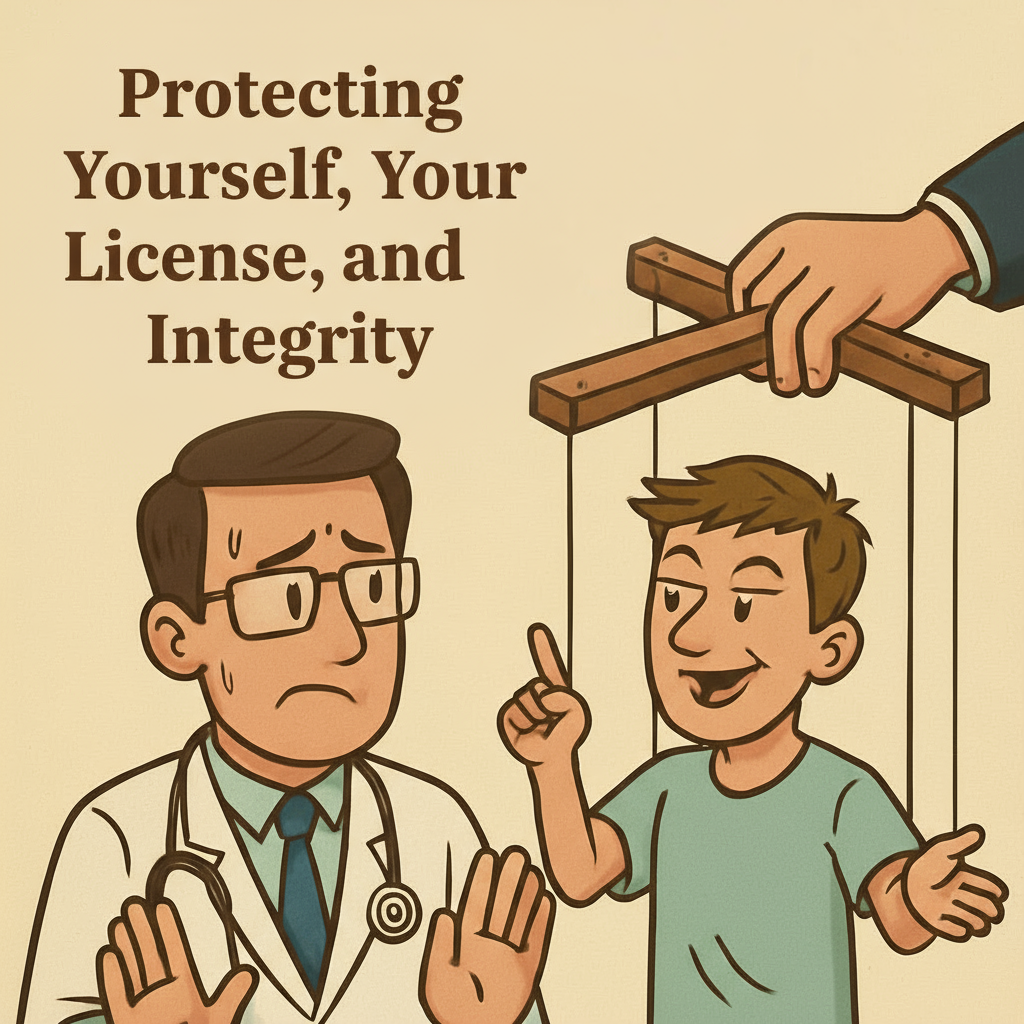
When Patients Manipulate: Protecting Yourself, Your License, and Your Integrity

Doug Jorgensen
May 7, 2025
There’s a quiet reality in clinical practice that most of us learn the hard way: not every patient who walks into your exam room is there with pure intentions. Some will push boundaries—gently at first, then more aggressively—until you’re outside your normal procedures, second-guessing your own rules, and at risk of making decisions you’d never ordinarily make.
Manipulation in medicine comes in many forms. Sometimes it’s a patient who refuses a chaperone for a sensitive exam, claiming they’re uncomfortable with another person in the room. Sometimes it’s a request to “bend the rules” for a prescription refill despite a clear violation of a controlled substance agreement. It might be a plea to expedite prior authorizations or bypass your practice’s normal approval process. And yes, sometimes it’s overtly sexual—flirtation, provocative dress, or suggestive comments aimed at influencing your judgment. I’ve even known cases where threats were involved—calls to the licensing board, hints about personal information, or implications that could damage a provider’s reputation.
The hard truth is this: as physicians, nurse practitioners, and physician assistants, we are held to a higher standard. That power dynamic—the fact that you hold authority over someone’s access to care—means that accusations alone can carry devastating consequences. We live in a culture where “accused” too often means “guilty until proven innocent,” and once your name is attached to a controversy, the damage is done.
I’ve testified in licensing board cases and served as both a plaintiff and defense expert. I’ve seen careers crumble because a provider ignored the warning signs of manipulation. Sometimes it’s ego—flattery, attention, or attraction clouding judgment. Sometimes it’s naivete. But the result is the same: the provider’s license, livelihood, and reputation are suddenly on the line.
I recall taking over care for a patient who had been seeing a colleague. She was charming, attractive, and entirely too comfortable using that to her advantage. She told me she’d been seen by other specialists who recommended escalating her medication. When I called those specialists, they told me the exact opposite—she was manipulative, fabricated her history, and was actively seeking controlled substances she was later caught selling. My colleague wasn’t a bad doctor; he was just taken in by her presentation and failed to verify the facts.
So, what’s the antidote? Double down on your protocols. If something feels off, bring in a chaperone, involve nursing or administrative staff, or call for a second opinion. In fact, I’m a huge advocate for second and even tertiary opinions—not as a sign of weakness, but as a hallmark of responsible, patient-centered care. A provider who objects to a second opinion is waving a red flag; so is a patient. Fresh eyes can catch blind spots we miss because of familiarity, bias, or the human desire to help someone we believe in.
Second opinions also remind patients that care is collaborative. I’ve sent people to some of the best minds in medicine—not because I doubted myself, but because they deserved every possible option, even if it meant hearing something I hadn’t considered. That’s how medicine should work.
Finally, we must remember that autonomy works both ways. Just as patients have the right to accept treatment, they have the right to refuse it—even if the choice shortens their life or worsens their condition. Our role isn’t to manipulate them into compliance any more than theirs is to manipulate us into risky behavior.
If you ever find yourself in that uncomfortable space where the line between patient advocacy and professional risk starts to blur, stop. Call a colleague. Get the second opinion. Protect your patient, but also protect yourself. Your license, your reputation, and your integrity are worth more than any single encounter.
About the Author
Douglas J. Jorgensen, DO, CPC, FAAO, FACOFP
Dr. Doug is a physician, consultant, and national educator on medical documentation accuracy, patient engagement, and compliance strategy. He helps healthcare organizations develop systems that make patients active partners in their own medical records.