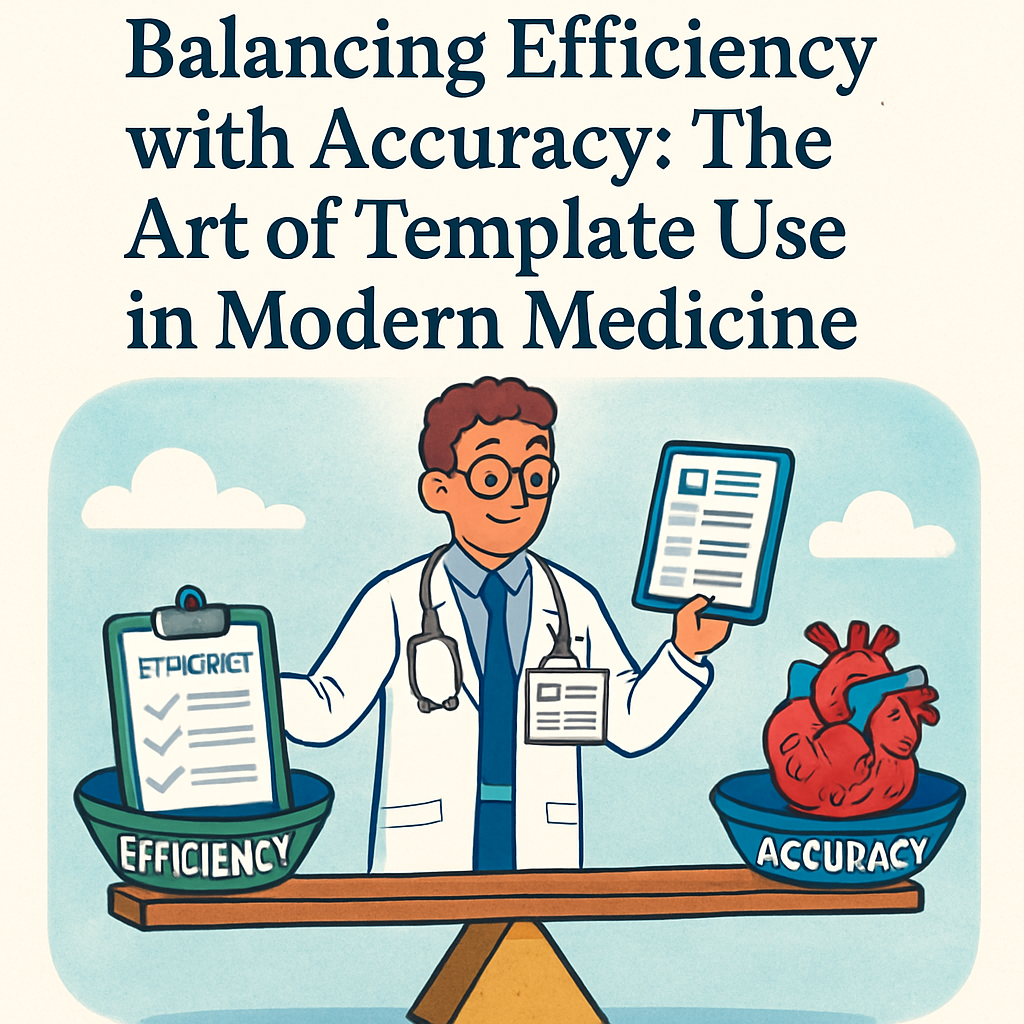
Balancing Efficiency with Accuracy: The Art of Template Use in Modern Medicine

Doug Jorgensen
May 5, 2025
When Electronic Health Records (EHRs) first arrived, they were pitched as the great equalizer—faster documentation, better communication, fewer errors. And in some ways, they’ve delivered. Templates, in particular, have given clinicians the ability to move through patient encounters without typing every detail from scratch. Click a few boxes, populate a few fields, and you’ve got a complete note in minutes.
But here’s the problem: speed doesn’t always equal accuracy. In fact, if we’re not careful, the very tool that’s meant to make our work easier can quietly chip away at the integrity of our records and, worse, our connection with the patient in front of us.
I’ve seen it happen in practices across the country—notes that look polished on the surface but crumble under scrutiny. A normal gait documented for a wheelchair-bound patient. “No new complaints” in a visit where the patient raised three new concerns. Identical language repeated across multiple charts with only the name and date changed. These aren’t just clerical slips—they’re liabilities. And more often than not, they come from over-reliance on templates.
The truth is, templates aren’t the enemy. They’re a tool—like a stethoscope or an otoscope. The danger lies in letting the tool dictate the work instead of the clinician. Used well, templates can ensure you never miss a required element for coding or compliance. They can prompt you to document important negatives, guide you through complex histories, and save you from retyping the same instructions over and over. But they can’t—and shouldn’t—replace the parts of a note that require your judgment, your reasoning, and your personal voice.
That’s the balance we have to strike: efficiency without losing authenticity. When you rely too heavily on default settings, copy-forward functions, or pre-checked boxes, your notes start to sound like they could belong to anyone. And that’s a problem, because your notes aren’t just for insurance companies. They’re for other providers who may treat your patient next week, for patients themselves who have the right to read what you’ve recorded, and for attorneys, auditors, and regulators who may review your work years down the line.
The best clinicians I know use templates as scaffolding, not as a finished product. They start with the structure, but they take the time to weave in the details that make the record truly accurate and specific to that encounter. They customize the assessment and plan in their own words. They verify every auto-populated field against what actually happened in the room. They trim the fat—removing the irrelevant, generic language that can clutter a note—and focus on the information that matters for patient care and compliance.
Does it take a little more time? Yes. But the payoff is huge. Your notes remain defensible. Your reasoning stays visible. And perhaps most importantly, you preserve the “doctor’s voice” in the record—the very thing that reassures patients and colleagues that you were fully present and engaged.
In today’s environment, with burnout rising and patient volumes climbing, it’s tempting to chase speed at all costs. But I’d argue that accuracy is the better long-term investment. A note that’s both efficient and accurate doesn’t just protect you from legal and financial risk—it improves the quality of care. Because at the end of the day, the record isn’t just about billing. It’s the story of your patient’s health, told through your eyes. And that’s a story worth telling well.
Templates should serve you—not the other way around. When they do, you can have both speed and precision without sacrificing the integrity of your work.
About the Author
Douglas J. Jorgensen, DO, CPC, FAAO, FACOFP
Dr. Doug is a physician, consultant, and national educator on medical documentation accuracy, patient engagement, and compliance strategy. He helps healthcare organizations develop systems that make patients active partners in their own medical records.