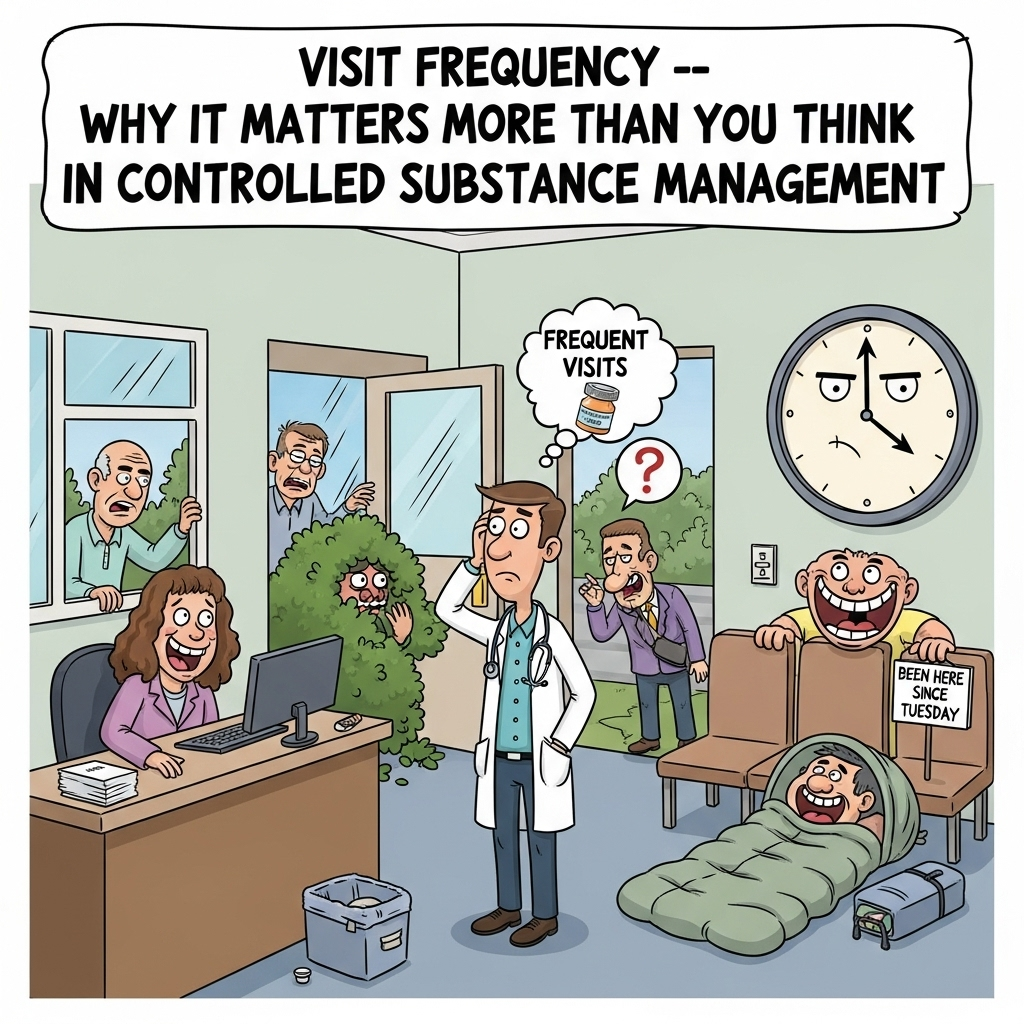
Visit Frequency — Why It Matters More Than You Think in Controlled Substance Management

Doug Jorgensen
May 17, 2025
In controlled substance prescribing, the interval between patient visits isn’t just a scheduling decision—it’s a clinical and compliance safeguard. The longer you go between visits, the more opportunities there are for problems to arise unchecked.
I’ve reviewed countless cases where a provider ended up in hot water—not because they prescribed inappropriately, but because they failed to maintain regular, documented follow-up. Regulators, insurers, and licensing boards see extended gaps in visits as a red flag.
Why Visit Frequency Matters
- Ongoing Risk Assessment – Patient circumstances, health status, and risk factors can change quickly.
- Early Detection of Misuse – Regular visits increase the chance of spotting red flags before they escalate.
- Better Clinical Outcomes – Frequent check-ins reinforce adherence and allow for timely treatment adjustments.
- Defensible Documentation – Shows regulators you’re actively monitoring therapy and not just issuing refills.
Recommended Visit Intervals
While every patient is different, here’s a general guideline I recommend for controlled substance patients:
- High-Risk Patients (history of misuse, aberrant behaviors, complex conditions): Every 30 days.
- Moderate-Risk Patients: Every 30-60 days.
- Low-Risk Patients (long-term stable, excellent compliance): Every 90 days—but never longer without a formal reassessment. BUT (hint, hint), there are no Low-Risk patients in the controlled substance space. Everyone starts at Moderate-Risk.
What to Cover at Each Visit
- Symptom and Function Review – Is the medication improving their quality of life?
- Side Effects and Safety – Any signs of over-sedation, dependence, or interactions?
- Compliance Checks – Review PMP data, pill counts, and urine drug testing when indicated.
- Goal Setting – Revisit treatment goals and determine if the plan still makes sense.
- Documentation – Every visit should tell the story of why ongoing prescribing is appropriate.
How Visit Frequency Protects Your License
I’ve served as an expert witness in cases where visit frequency—or the lack of it—made or broke the defense. If you can show a consistent pattern of in-person evaluation with supporting notes, you’ve got a strong case. If you can’t, you’re vulnerable—even if your clinical decisions were sound.
Bottom Line
Visit frequency isn’t just about keeping the schedule full—it’s a key part of responsible, defensible controlled substance management.
In compliance, time is a variable you control. Use it wisely, and it can protect both your patients and your license.
About the Author
Douglas J. Jorgensen, DO, CPC, FAAO, FACOFP
Dr. Doug is a physician, consultant, and national educator on medical documentation accuracy, patient engagement, and compliance strategy. He helps healthcare organizations develop systems that make patients active partners in their own medical records.