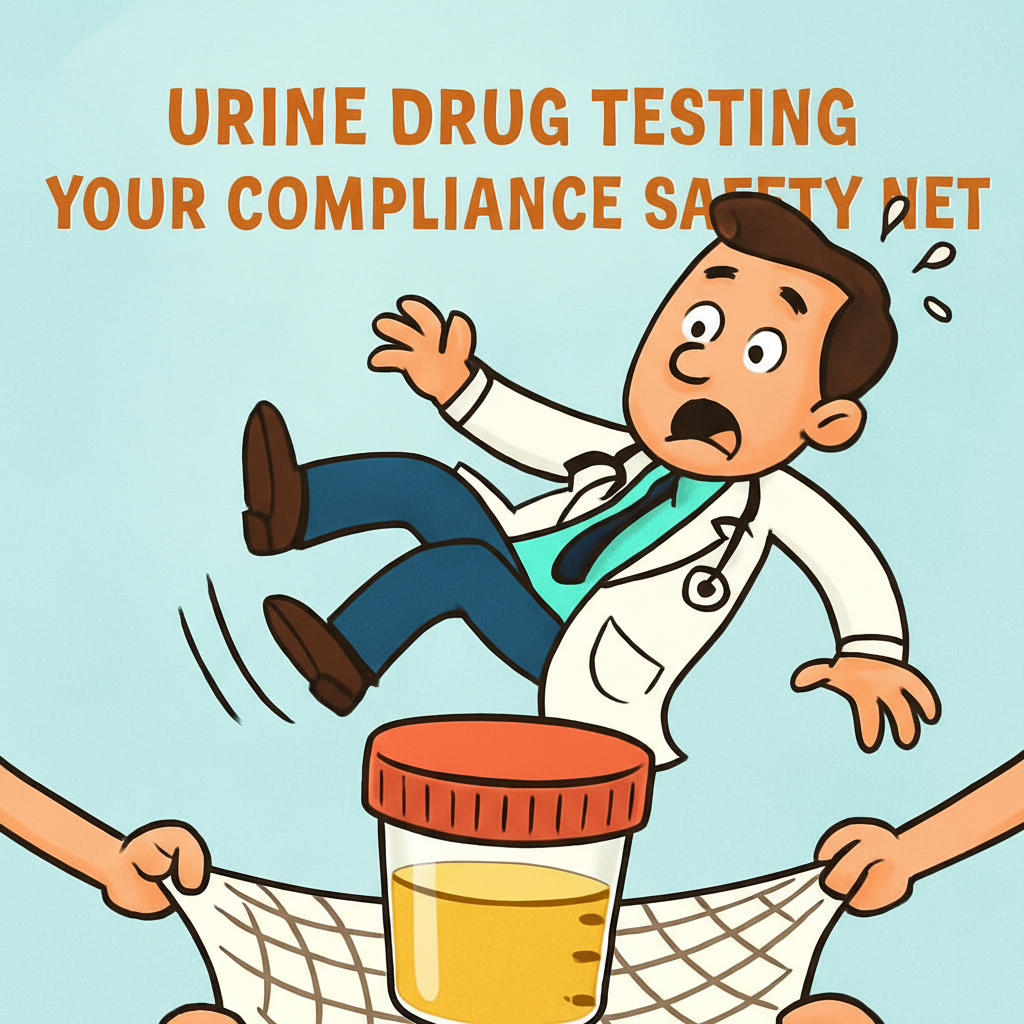
Urine Drug Testing — Your Compliance Safety Net

Doug Jorgensen
May 13, 2025
In the world of controlled substance prescribing, one tool consistently proves its worth in both patient safety and provider protection: urine drug testing (UDT).
Yet despite its value, I still see clinicians treating UDT as optional—or worse, as something to do only when a patient “looks suspicious.” That’s a mistake. Done correctly and consistently, UDT is one of the strongest safeguards you have against misuse, diversion, and allegations of unsafe prescribing.
Why Urine Drug Testing Matters
Urine drug testing isn’t about catching people—it’s about confirming reality.
- Confirms Compliance – Ensures the patient is taking the medication as prescribed.
- Identifies Undisclosed Substances – Alerts you to illicit drug use or unreported prescriptions.
- Supports Clinical Decisions – Provides objective data when evaluating ongoing treatment.
- Strengthens Legal Defense – Demonstrates proactive risk mitigation to boards, insurers, and regulators.
When to Test
I recommend a structured testing schedule for all controlled substance patients:
- Baseline Test – At initiation of therapy.
- Random Tests – At least once or twice annually for low-risk patients, more often for high-risk.
- For Cause – Immediately when there’s a red flag—early refill requests, inconsistent PMP reports, missed appointments, or behavioral concerns.
How to Do It Right
- Set the Expectation Early
- Include UDT requirements in your Controlled Substance Agreement.
- Explain to patients that testing is standard practice for all, not a sign of mistrust.
- Include UDT requirements in your Controlled Substance Agreement.
- Document Every Step
- Record when the test was ordered, why, and the results.
- If results are unexpected, note your clinical reasoning for next steps.
- Record when the test was ordered, why, and the results.
- Confirm Unexpected Results
- False positives and false negatives happen. Always send confirmatory testing before making major care decisions. Screening urines are not actionable.
- False positives and false negatives happen. Always send confirmatory testing before making major care decisions. Screening urines are not actionable.
- Respond Consistently
- Follow a written policy for how you handle aberrant results. Inconsistency invites legal trouble.
- Follow a written policy for how you handle aberrant results. Inconsistency invites legal trouble.
A Case in Point
I once reviewed the case of a provider under investigation for overprescribing. Their saving grace? A clear record of regular UDT, documented results, and a consistent protocol for addressing unexpected findings. The board concluded the provider had taken reasonable steps to ensure safe prescribing—and the case was closed without action.
Bottom Line
Urine drug testing isn’t just about compliance—it’s about good medicine. It protects the patient, helps you make better clinical decisions, and gives you a defensible position if your prescribing is ever questioned.
In controlled substance management, trust is essential—but verification is non-negotiable.
About the Author
Douglas J. Jorgensen, DO, CPC, FAAO, FACOFP
Dr. Doug is a physician, consultant, and national educator on medical documentation accuracy, patient engagement, and compliance strategy. He helps healthcare organizations develop systems that make patients active partners in their own medical records.