When Patients Refuse Care — Understanding Rights, Risks, and Responsibilities

Doug Jorgensen
May 9, 2025
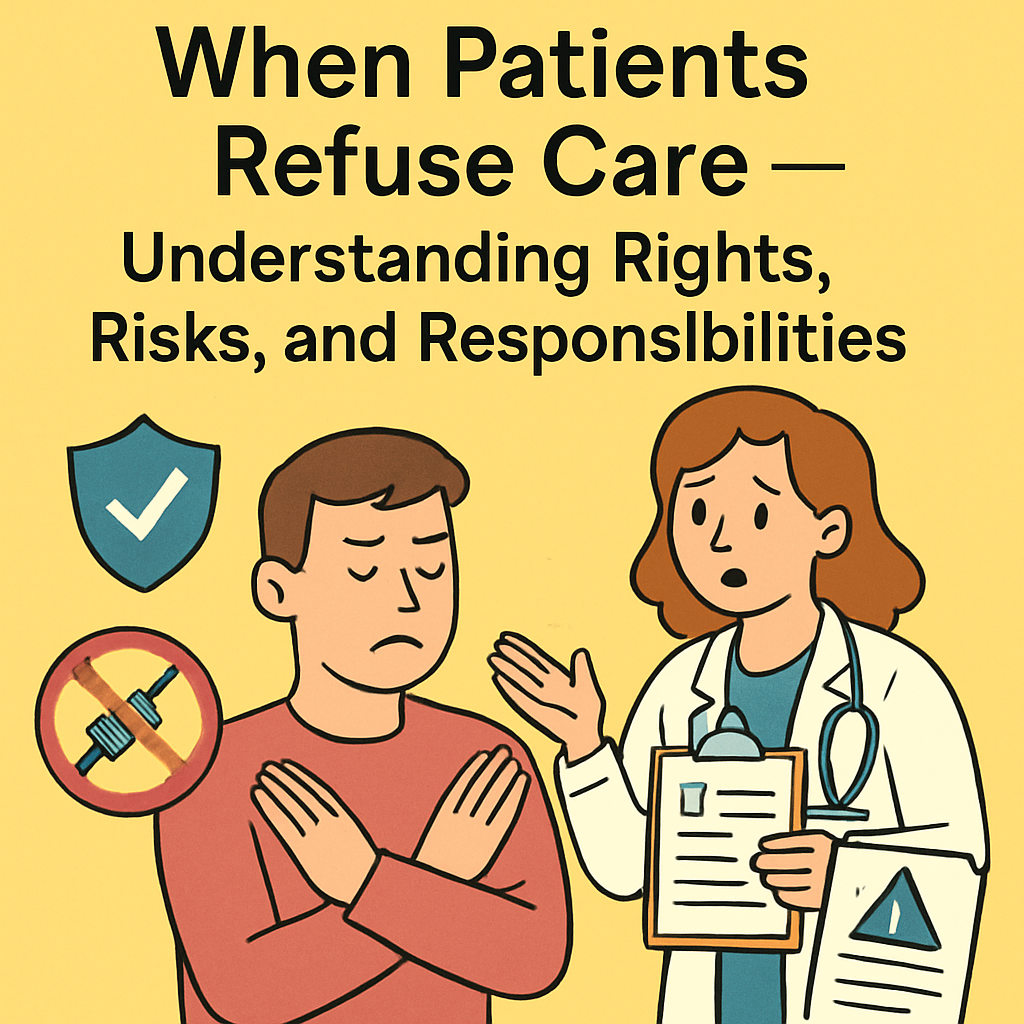
One of the hardest moments in medicine is when a patient refuses care you know they need. It’s even harder when that refusal will almost certainly lead to worsening health—or death.
As providers, our instinct is to fix. We’ve trained for years, built our skills, and dedicated our careers to improving lives. But here’s the reality: patients have the right to say no—even when we believe that choice is harmful.
The Legal and Ethical Foundation
In the United States, competent adults have the right to accept or refuse medical treatment. This principle, rooted in both law and medical ethics, is about autonomy—the patient’s ability to make informed decisions about their own body.
For a refusal to be valid, the patient must:
- Have decision-making capacity – They understand the information, the risks, and the alternatives and have no medical or psychiatric pathology impeding understanding or decision-making.
- Be fully informed – They’ve been told, in clear terms, what the recommended treatment is, why it’s needed, and what could happen if it’s refused.
- Make the choice voluntarily – Without coercion, manipulation, or undue pressure.
Your Responsibilities as a Provider
When a patient refuses care, your role shifts from persuader to documentarian and protector—of both the patient’s rights and your own professional integrity.
- Educate Clearly – Explain the diagnosis, treatment options, and likely outcomes of refusing care in plain language.
- Assess Capacity – If there’s any doubt, document a capacity evaluation.
- Offer Alternatives – Even if they refuse the primary recommendation, provide other options that may be more acceptable.
- Document Thoroughly – Record exactly what was discussed, the patient’s stated reasons for refusal, and your assessment of their understanding.
- Have a Witness – When possible, involve a nurse or other staff member to confirm the conversation.
The Risk of Doing Nothing
Sometimes, refusing care puts the patient’s life in immediate jeopardy. In rare cases—such as public health emergencies, imminent danger to self or others, or situations involving minors—the law may allow or require intervention. But for most competent adults, we must respect their decision, no matter how much it conflicts with our own medical judgment.
A Real-World Example
I once treated a man with a severe infection that, left untreated, could have become life-threatening within days. I explained the risks, the necessity of hospitalization, and the potential consequences. He understood—but refused, citing personal reasons. I documented every detail of our conversation, had a nurse witness it, and gave him clear written instructions on warning signs that required immediate attention. Two days later, he returned—worse and nearly septic, but alive—and finally agreed to treatment.
Balancing Respect and Responsibility
It’s not our job to control patients—it’s our job to inform, guide, and respect. By clearly communicating risks, documenting the refusal process, and leaving the door open for future care, we protect not only the patient’s rights but also our professional license.
A patient’s “no” today doesn’t mean “no” forever. Your professionalism in the moment may be what brings them back tomorrow.
About the Author
Douglas J. Jorgensen, DO, CPC, FAAO, FACOFP
Dr. Doug is a physician, consultant, and national educator on medical documentation accuracy, patient engagement, and compliance strategy. He helps healthcare organizations develop systems that make patients active partners in their own medical records.