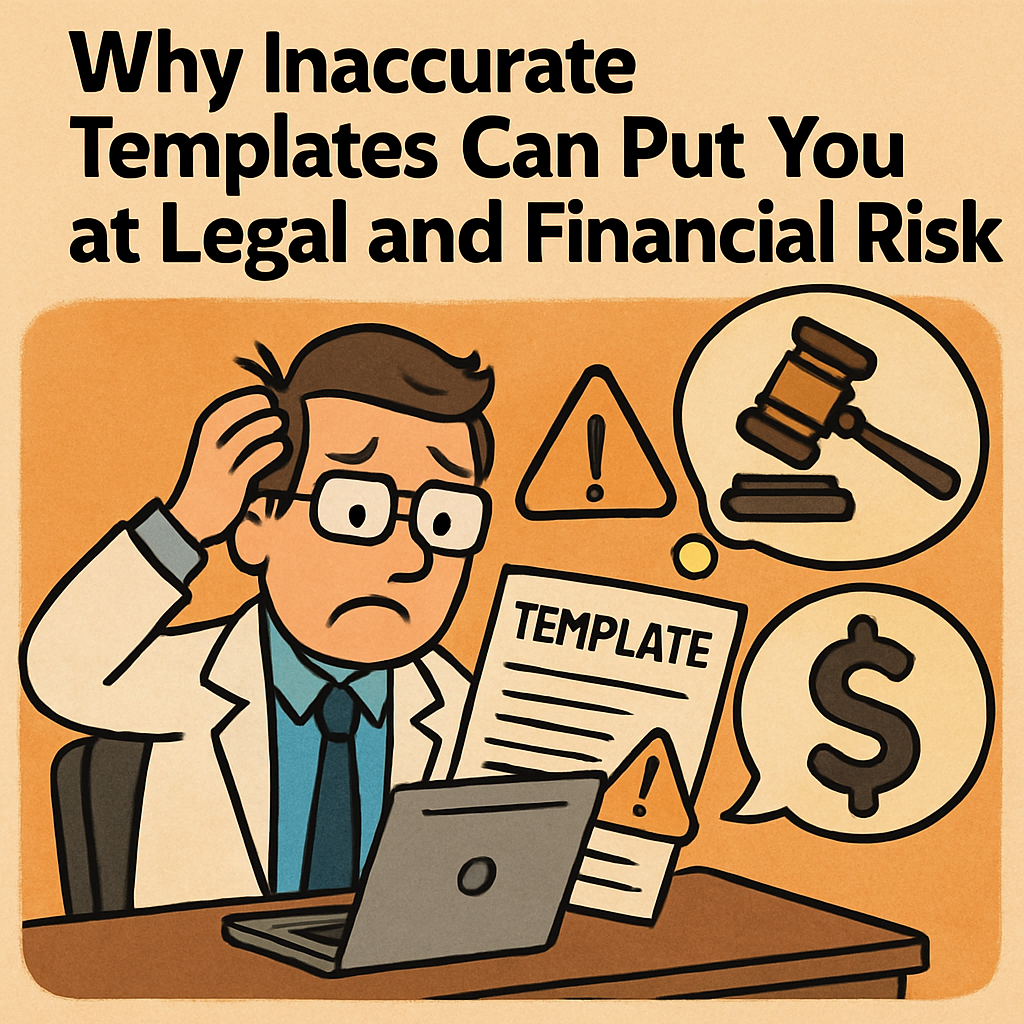
Why Inaccurate Templates Can Put You at Legal and Financial Risk

Doug Jorgensen
April 29, 2025
Introduction: The Hidden Danger in Your Own EHR
EHR templates are meant to streamline documentation, but when they’re inaccurate, outdated, or used carelessly, they can create serious legal, financial, and professional consequences.
A bad template isn’t just inefficient—it’s a liability waiting to happen.
Step 1: How Templates Become Inaccurate
- Outdated Content – Medical guidelines and coding requirements change, but templates are rarely updated promptly.
- Copy-Forward Errors – Carrying forward old information that no longer applies to the patient.
- Overgeneralization – One-size-fits-all language that doesn’t match the specifics of the encounter or there is simply too much documentation for a quick follow-up visit..
- Unchecked Defaults – Pre-filled “normal” findings that may not reflect reality, or worse contradict history and physical exam findings..
Step 2: The Legal Risks
- Fraud Allegations – If documentation suggests a service or finding that wasn’t provided, regulators can view it as false billing. Intent doesn’t need to be proven for fraud prosecution; only that the act occurred.
- Malpractice Exposure – Inaccurate notes can weaken your defense if care is questioned in court.
- Loss of License – Repeated documentation errors, especially in controlled substance cases, can trigger disciplinary action.
Step 3: The Financial Risks
- Claim Denials – Payers reject documentation that doesn’t meet their requirements.
- Recoupment Demands – Audits can result in repayment of years’ worth of claims.
- Reduced Reimbursement – Inaccurate coding tied to poor template use can mean leaving money on the table.
Step 4: Compliance Fallout
Auditors are trained to spot “template abuse” patterns:
- Identical notes for multiple patients.
- Implausible findings (e.g., “Normal gait” for a wheelchair-bound patient).
- Documentation that contradicts test results or medication lists.
Even if these errors are unintentional, they damage your credibility and can lead to increased scrutiny.
Step 5: How to Protect Yourself
- Review Every Note Before Signing – Never rely solely on the template output.
- Update Templates Regularly – Ensure compliance with current laws, coding, and clinical standards.
- Customize for Each Patient – Use templates as a starting point, but always individualize findings and plans.
- Limit Copy-Forward – Only carry forward what you’ve personally verified that day.
- Audit Yourself – Periodically review random charts to catch issues before an external auditor does. Better yet hire an objective 3rd party to audit you against industry standards and your peers.
Step 6: Train Your Team
- Ensure all providers, scribes, and staff understand that every checkbox and phrase in a note carries legal weight.
- Provide examples of real-world audit findings caused by bad template use.
Common Mistakes to Avoid
- Thinking “it’s just a template” so it doesn’t need verification.
- Copying notes from another provider without reviewing.
- Failing to remove auto-filled normal findings when abnormal results are present.
- Using outdated coding prompts that no longer meet payer requirements.
Final Thoughts: Accuracy First, Always
Templates are powerful tools—but if they’re wrong, they can take you down faster than they help you.
The cost of an inaccurate template isn’t just money—it’s your credibility, compliance status, and career.
The safest template is the one you verify, update, and tailor every single time.
About the Author
Douglas J. Jorgensen, DO, CPC, FAAO, FACOFP
Dr. Doug is a physician, consultant, and national educator on documentation integrity, EHR optimization, and compliance risk mitigation. He helps providers identify and correct documentation vulnerabilities before they become costly liabilities.