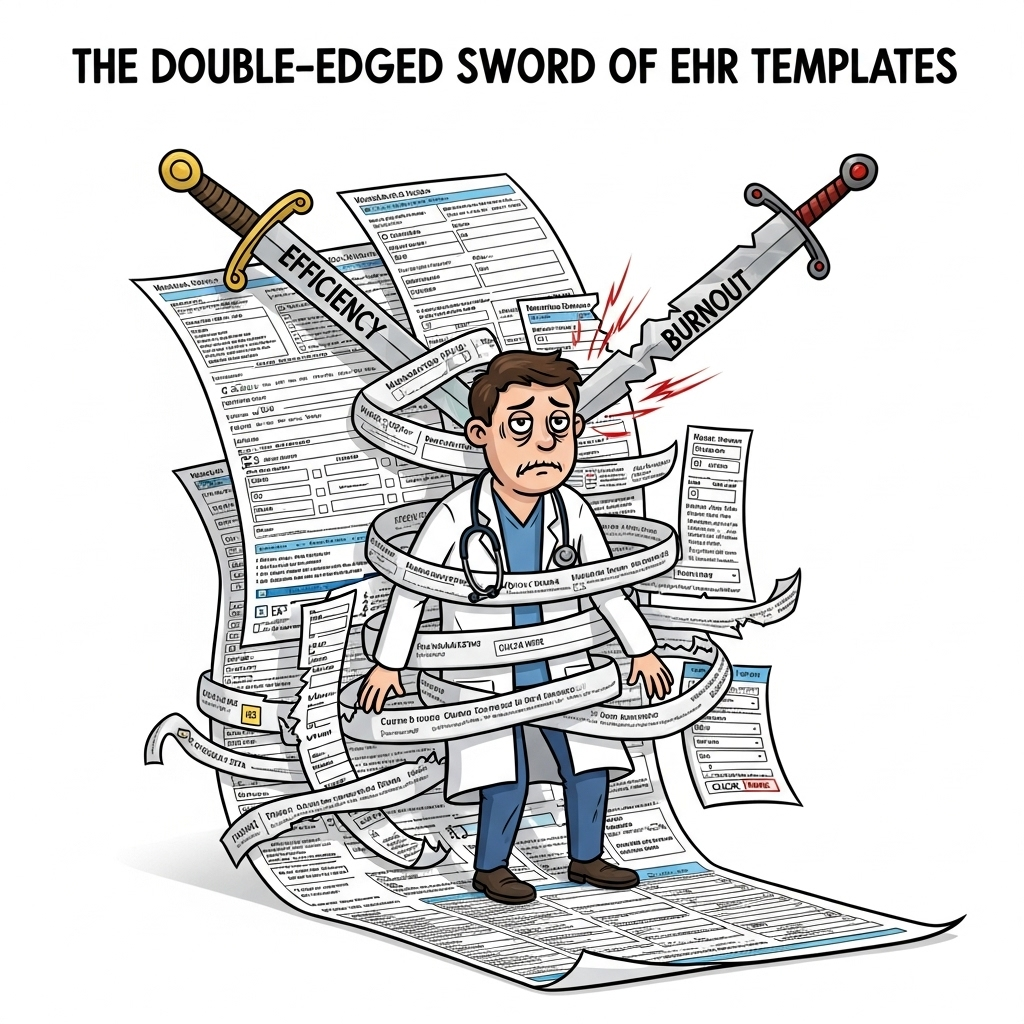
The Double-Edged Sword of EHR Templates

Doug Jorgensen
April 27, 2025
Introduction: A Tool That Can Help—or Hurt—Your Practice
Electronic Health Record (EHR) templates were designed to make documentation faster, easier, and more consistent.
Used wisely, they do exactly that.
Used carelessly, they can create compliance problems, legal exposure, and clinical errors.
A template can save you minutes or cost you your license—it depends on how you use it.
Step 1: The Advantages of Templates
- Efficiency – Common phrases, checkboxes, and auto-fill fields reduce typing time.
- Consistency – Ensures required elements for coding and compliance are captured.
- Standardization – Helps maintain uniformity across providers in the same practice.
- Prompts for Completeness – Reduces the chance of forgetting key elements in a patient encounter.
Step 2: The Risks of Over-Reliance
- Copy-Paste Errors – Outdated information can be carried forward for months or years.
- Inaccuracy – Pre-checked boxes that don’t reflect the actual encounter.
- Loss of Clinical Nuance – The patient’s story can disappear into generic phrases.
- Audit Red Flags – Repeated identical notes can suggest fraudulent documentation, even if unintentional.
Step 3: Legal and Compliance Pitfalls
Regulators and payers are well aware of “template abuse”:
- Inaccurate notes can be viewed as false claims if they lead to billing for services not provided.
- Copy-forward without verification can be considered fraudulent documentation.
- Courts can challenge the credibility of your records if they appear generic or implausible.
Step 4: Best Practices for Using Templates
- Verify Every Field – Never assume the default setting is correct.
- Edit for Accuracy – Replace generic text with patient-specific details.
- Use Free-Text Where It Matters – Preserve your clinical reasoning in your own words.
- Limit Copy-Forward – Only carry forward information that you have confirmed is still accurate.
- Update Templates Regularly – Ensure they reflect current best practices and guidelines.
Step 5: Balancing Efficiency with Accuracy
- Use templates as a framework, not a finished product.
- Remember: a note should sound like it came from a human clinician, not a form.
- If a patient’s condition deviates from the template norm, make sure your note reflects that.
Common Mistakes to Avoid
- Relying on pre-checked boxes without review.
- Allowing templates to dictate clinical thinking.
- Assuming “everyone does it” makes questionable practices acceptable.
- Failing to update templates for new laws, payer requirements, or treatment protocols.
Final Thoughts: The Template Is Only as Good as the Clinician Using It
EHR templates are powerful—but like any powerful tool, they demand skill, attention, and discipline.
The goal is to leverage them for efficiency without sacrificing accuracy, nuance, or compliance.
Let the template work for you, not against you.
About the Author
Douglas J. Jorgensen, DO, CPC, FAAO, FACOFP
Dr. Doug is a physician, consultant, and national educator on healthcare compliance, documentation integrity, and EHR optimization. He helps providers use technology wisely while protecting the accuracy and credibility of their medical records.