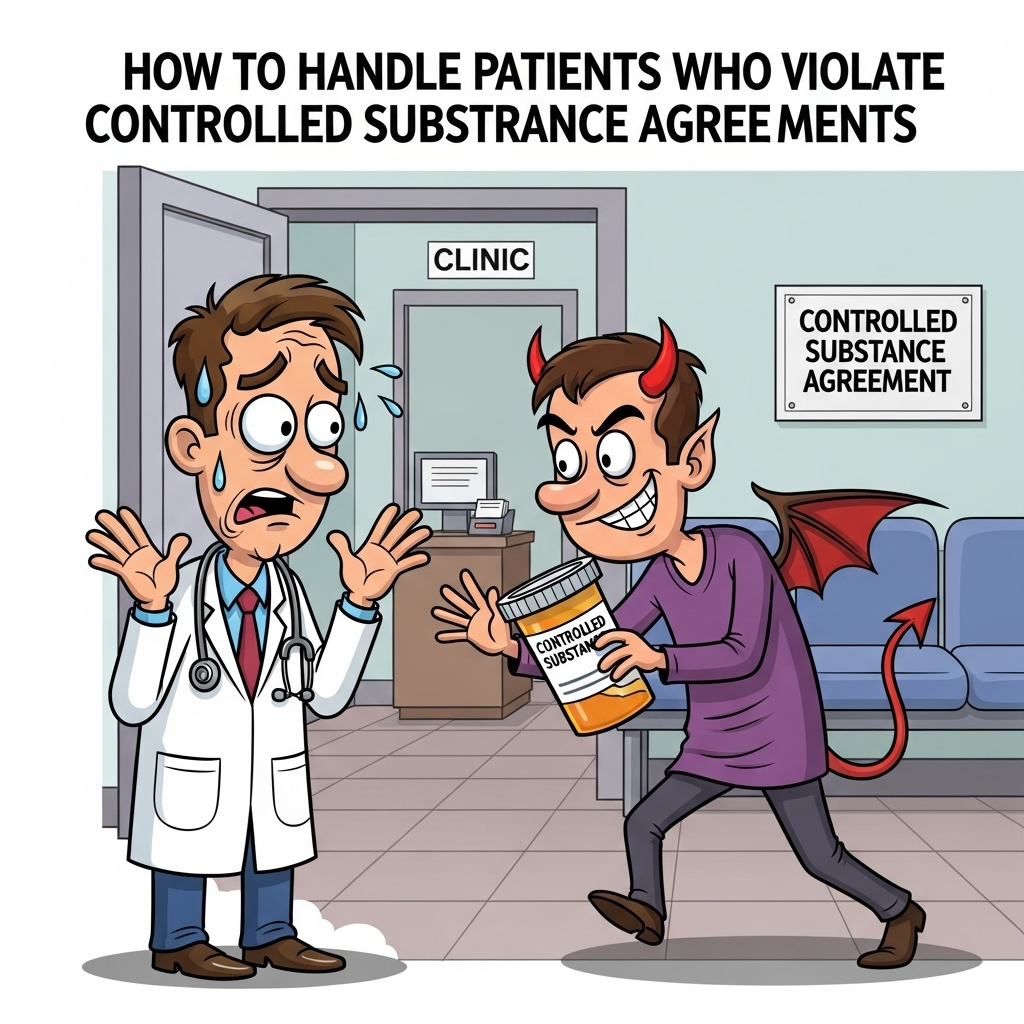
How to Handle Patients Who Violate Controlled Substance Agreements

Doug Jorgensen
April 23, 2025
Introduction: Policy Without Enforcement Is Just Paper
A Controlled Substance Agreement (CSA) only works if you enforce it.
When violations occur, you must respond in a clear, consistent, and documented manner—both for patient safety and regulatory protection.
The way you handle violations sends a message to your patients, your staff, and regulators about your commitment to safe prescribing.
Step 1: Define What Constitutes a Violation
Common CSA breaches include:
- Early refill requests without a legitimate reason.
- Abnormal urine drug test results (e.g., absence of prescribed drug, presence of non-prescribed substances).
- Missed pill counts or refusal to participate.
- Obtaining controlled substances from another provider without disclosure.
- Evidence of diversion or unsafe storage.
Step 2: Confirm the Facts Before Acting
- Verify the evidence – Review PMP data, lab results, and pill count logs.
- Consider possible explanations – Miscommunication, lab error, or legitimate travel can mimic violations.
- Avoid assumptions – Gather all relevant information first.
Step 3: Address the Issue Directly With the Patient
- Schedule a face-to-face discussion whenever possible.
- Present the facts without accusation.
- Give the patient an opportunity to explain their side.
- Maintain professionalism—keep the conversation about safety, not morality.
Step 4: Document the Conversation and Findings
- Record the date, time, and participants in the discussion.
- Summarize the violation and the patient’s explanation.
- Note the outcome or next steps decided upon.
Step 5: Apply Consequences Consistently
Depending on the severity and nature of the violation:
- Minor or first-time infraction – Increased monitoring, shorter prescription intervals, additional education.
- Repeated or serious violations – Gradual medication taper, discontinuation of controlled substances, or referral to addiction treatment.
- Evidence of diversion or illegal activity – Immediate discontinuation, notification of authorities when legally required.
Step 6: Maintain Patient Safety During Discontinuation
- Avoid abrupt discontinuation when possible—unless safety dictates otherwise.
- Provide tapering schedules to prevent withdrawal.
- Offer alternative treatments or referrals.
Step 7: Protect the Provider–Patient Relationship (If Possible)
- Reinforce that the action is about safety and compliance, not punishment.
- Encourage the patient to stay engaged in non-controlled-substance care.
- Avoid unnecessary termination from the practice unless risk is too great.
Common Mistakes to Avoid
- Inconsistent enforcement – Weakens credibility and invites legal scrutiny.
- Lack of documentation – Without records, it’s your word against theirs.
- Overreacting without verification – Can harm the provider–patient relationship unnecessarily.
- Ignoring violations – Signals to staff and regulators that policies are meaningless.
Benefits of a Structured Violation Response
- Maintains fairness and consistency across patients.
- Demonstrates compliance to regulators and payers.
- Protects against legal and liability exposure.
- Preserves patient trust when handled respectfully.
Final Thoughts: Firm, Fair, and Documented
Handling CSA violations isn’t pleasant—but done well, it reinforces the integrity of your compliance program and ensures patient safety.
Patients respect boundaries when they see they are enforced consistently, fairly, and professionally.
About the Author
Douglas J. Jorgensen, DO, CPC, FAAO, FACOFP
Dr. Doug is a physician, consultant, and national educator on healthcare compliance and risk mitigation. He trains providers on how to enforce controlled substance policies with professionalism, consistency, and compassion.